An Illustrated Family History Archive
Contents

Blog

Note: This blog constitutes just the family history category entries from my main blog, which you can visit here.

Who Were Donald Cameron's Parents? Part II

Thursday 7 May 2026

Cameron and Chromosome 13

At the end of my article Who Were Donald Cameron's Parents? I mentioned a DNA puzzle that may hold the key to Donald's ancestry where the genealogical record is missing.

The link became apparent as I started connecting a number of Cameron DNA matches on Ancestry in the 4th-cousin range (23-37 cM), who I could place as descendants of my 3xg-grandparents, Donald Cameron (c.1810-1887) and Catherine Campbell (c.1815-1889), and noted a number of mutual matches in the 17-31 cM range who I could not identify.

If this sounds like gobbledegook, let's pause for a quick explanation. Every person has DNA - the genetic code that makes you ... you! You get half from your mother and half from your father. They, in turn got half from each of their parents, meaning that your DNA is also made up of a quarter from each of your grandparents, an eighth (or thereabouts) from your great-grandparents, and so on. The further back you go, the wider the variation in those segments of DNA because inheritance amounts are not precise.

As an example, let's take a fourth cousin - that's someone who shares a set of 3xg-grandparents with you which, mathematically, would mean you'd have 3.125% of their DNA, though the reality, due to the randomness of inheritance at this distance, means it's actually anywhere from 0 to 0.9%. Some people are surprised to learn that you don't share DNA with everyone you're related to, and you will usually share DNA with only half of your 4th cousins, and 10-15% of your 5th cousins (remembering of course, you'll have many more 5th cousins than 4th cousins). The amount you share can also be measured in centimorgans (cM), which for a 4th cousin would be mostly in the 20-85 cM range, averaging about 35cM.

Back to the mystery matches ... after some research into their trees, where they had them, I found the majority were descended from one Alexander Lamont (1761-1845) and his wife Eunice Currie (1771-1859) who hailed from Kingsburgh on the Isle of Skye, a completely separate geography from my Perthshire Camerons. The Lamonts had a couple of children on Skye before they emigrated on one of Lord Selkirk's vessels, the Polly, landing at Prince Edward Island in 1803 where they had more children and lived out the rest of their lives.

As my research continued I discovered some of these Lamont/Currie descendants on other DNA platforms that, unlike Ancestry, had chromosome browsing available, where you can see a visualisation of the DNA segment match, so I was able to identify the common DNA segment as being on chromosome 13 (chr13). But how is that useful?

Not including the X and Y sex chromosomes, we each have 22 pairs of 'autosomal chromosomes', the pairs being one maternal and one paternal. In this case the matches are on my paternal chromosome 13.

The diagram below represents the full length of my paternal chr13 and the blue area is where my paternal aunt (LC0) matches me on that chromosome - that is to say we share the same sequence of genetic markers in that segment. We're closely related, sharing 24.4% in all (though 38.7% of chr13), the expected amount for an aunt, uncle, grandparent or half-sibling.

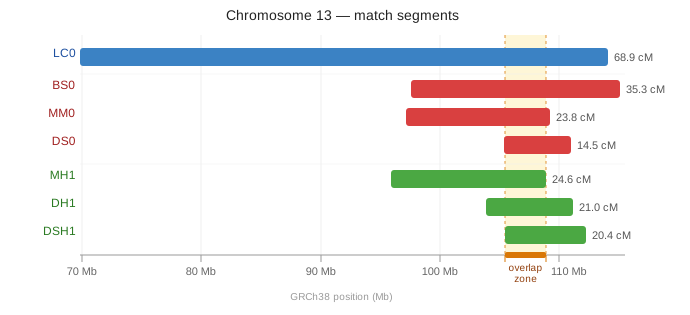
Now let's see how these other matches fit. In the diagram below the blue again represents my aunt's match with me - so we're just looking at the end third or so of chr13. The red bars are three of my known Cameron fourth cousins and the green bars are three descendants of Alexander Lamont and Eunice Currie from Skye. The overlap zone indicates where all the segments match each other,

It should be noted that a relative can match you on multiple chromosomes. So my aunt matches me on every paternal-side chromosome by various amounts, often with multiple segments - as expected for such a close relative. Of the fourth cousins in the above diagram, MM0 and DS0 match me on two chromosomes while BS0 matches me on just one. As for the Lamont/Currie descendants, MH1 matches me on three different chromosomes, while the remaining two match only on chr13.

Knowing which chromosome, and where on that chromosome your DNA match coincides can tell you who they're related to. If you know how you're related to a match - in this case my aunt and fourth cousins - then anyone else who matches in that same area will share the same ancestral root. We all received the chr13 segment, in various lengths, passed down through the generations intact from the same person. In other words, we're related. The next thing to work out is how we're related.

I had hoped this would be the break-through moment - perhaps finding that one of the Lamont/Currie parents was a McDonald or a Cameron who had a niece or nephew who would turn up in the Little Dunkeld area of Perth, revealing themselves as one of Donald Cameron's parents. But instead of narrowing down the search, the more I dug, the more chr13 matches I found - currently around 75 - and the wider the pool seemed to get. To add to the pool there are also all the mutual matches on Ancestry where I don't have chromosome data, but who do share DNA and help to confirm the general genealogical picture.

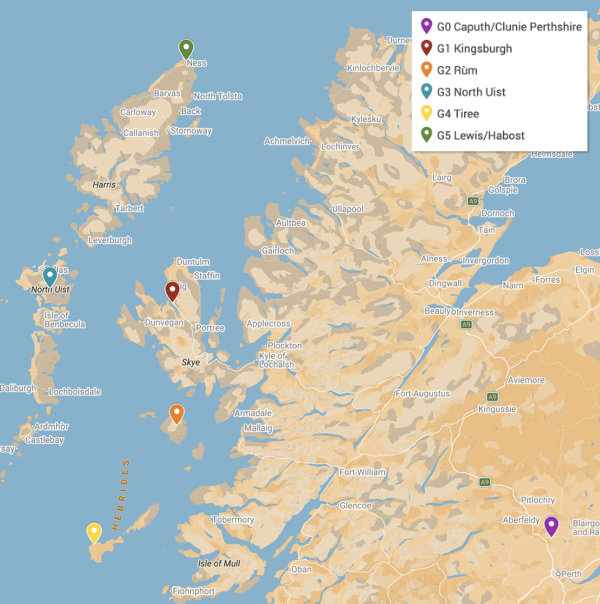
With this data other family groups emerged who have no obvious link to the Lamont/Currie families and after a few years of on-and-off research, I organised these into seven groups (G0-G6), as follows:

Group 0 (G0) - these are my known Cameron cousins, descendants of Donald Cameron (1810) & Catherine Campbell (1815) of Clunie, Perthshire. While I currently have almost 30 Cameron DNA matches, I've only been able to confirm four of them as having the chr13 segment, though there are a handful of others that are mutual matches on Ancestry with members of other groups, mostly G1. Catherine Campbell's DNA will also show up within this group, of course, but I feel fairly confident the chr13 signal comes through Donald as Catherine's ancestry points strongly to Caithness for both parents and Caithness is not a prominent presence in the matching groups - all possibilities remain open, however, so Catherine's ancestry can't be totally dismissed.

Group 1 (G1) - descendants of Alexander Lamont (1761) & Eunice Currie (1771) of Skye that emigrated to Prince Edward Island. This group has some of the strongest cM matches - as high as 31cM (in the 4th-6th cousin zone) - though any common ancestor with my line must predate Alexander and Eunice as they moved abroad well before any of their descendants had families of their own. Some in this group have subsidiary lines that lead into G5 territory. 21 matches so far, with eight confirmed as chr13.

Group 2 (G2) - three descendants (all chr13) of Norman McLean (1792) and Ann McKinnon (1792) of the Isle of Rum, victims of the 1826 clearance who ended up in Cape Breton, specifically Whycocomagh. Another line of this group (for two of the matches) leads to McDonalds of Dull, Perthshire, which feels significant, but might be a red herring.

Group 3 (G3) - descendants of Angus McLellan (1781) & Marion Monk (1795) of North Uist with descendants in both Scotland and Nova Scotia. This is a sparsely matched group (just 5, all closely related to each other, but 4 known to have the chr13 segment) and has other lines that wander into G5 territory, so the group could do with a few more matches to help confirm the right direction.

Group 4 (G4) - nine descendants (four chr13 confirmed) of Allan Cameron (1776) and Mary McLean (1762) of Tiree, Argyll, with emigrant branches ending up in the US and Canada, or staying in Scotland. The Cameron name seems very significant, but, again, could be a red herring. Allan Cameron does have a brother, John Cameron (1778) who would be the right generation to father Donald of Clunie, but so far it looks like he may have married and had family in Tiree - though that's not a solid confirmation, and needs to be kept open. There's also a strong McLean line and the Tiree families are peppered with Lamonts which might point back to G1, but, so far, not obviously so.

Group 5 (G5) - a large endogamous group with multiple common ancestors from the Isle of Lewis, particularly Barvas and Stornoway. Common names include McLean, McKenzie, Morrison, Murray, McDonald, McRitchie, McLeod and Campbell to name a few. An absolute nightmare to sort out when you have, for example, a Norman McLean marrying a Catherine Morrison whose parents were Norman Morrison and Catherine McLean, or a Donald McKenzie of Eorodale who married Margaret McKenzie of Habost, right next to a Margaret McKenzie of Eorodale who married a Donald McKenzie of Habost. Ancestry trees from this group are littered with errors and wrong turns. I've identified 21 matches so far who share various common ancestors in this group, six of whom I've been able to confirm as having the chr13 segment.

Group 6 (G6) - this is populated by any match who I've been as yet unable to home. It includes 45 confirmed chr13 matches, and a large number of Ancestry mutuals.
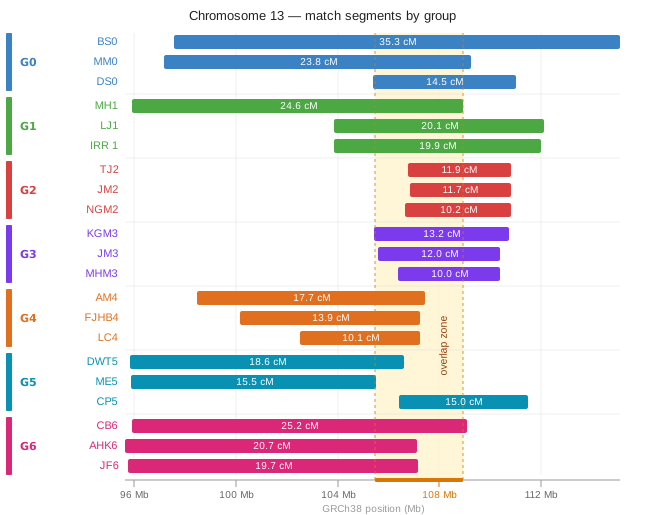

Match segments with my chromosome 13, three from each group

One of the most important things to confirm with these groups is whether or not they triangulate - in other words, not only is the same chr13 segment common to all of them, but do they also match each other at that genetic location? I validated this by creating a match matrix.
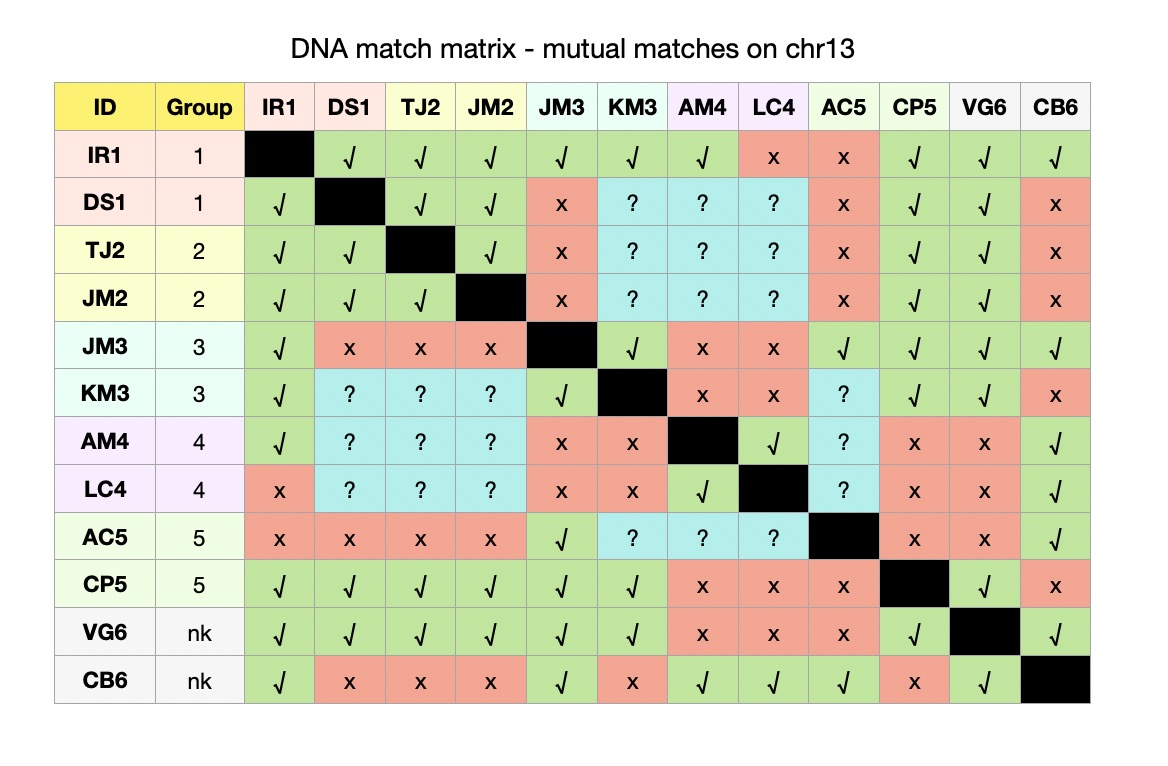
Two chr13 representatives from each group; green (tick) means they match; red (x) means they don't match; and blue (?) means I was unable to compare them due to different platforms

As you can see from the above table, representatives of each group match across all other groups, the conclusion being that, even though I have not been able to link the groups, they must all share a common ancestor, or at least an ancestral population, somewhere back in time.

But having taken many of the groups back to the mid to late 1700s no clear common ancestor has emerged. Hebridean records are very poor, even in the 1800s, and largely non-existent back into the 1700s, so it is pretty much a foregone conclusion that the originator of the chr13 segment that was passed down into all these groups, as well as into my own Cameron line, will remain unknown.

We can guess that any common ancestor to all these groups must be at least a couple of generations before the earliest we have identified, which would place them in the early 1700s, and possibly more safely into the late 1600s. At that distance we'd be looking at matches who are in the 8th or 9th cousin range with very few of them having any shared DNA at all, and only then in tiny segments. Having said that, the likelihood of perceptible DNA showing up is made more possible purely through the sheer number of 8th or 9th cousins that exist - likely in the tens-to-hundreds of thousands.

Another factor that would increase the cM count from such a distance would be endogamy, which is already very apparent in the G5 Isle of Lewis trees where many matches appear with multiple common ancestors - it's a group made up of a number of sub-groups, a well-recognised phenomenon within such a closed geographical kin network that leads to reduced genetic diversity.

In some ways it might seem as though all this research (and it has been a lot) has got us no closer to identifying Donald Cameron's parents, and, while that may be true, it has actually shone a light into a new and significant direction.

We cannot be certain of the names of Donald Cameron's parents, only that his death certificate records them as John Cameron and Ann McDonald and that the accuracy of this cannot be validated. Certainly McDonald is a strong Hebridean name, particularly connected with Skye and Uist, spreading later into Lewis. Cameron features strongly in G4, though it doesn't necessarily mean we're looking at the paternal ancestor here - it is not originally a Hebridean name - and it could just as easily be the female McLean line that passed it down.

But one thing it does tell us, and it is very useful new information, is that Donald Cameron has heritage that originates outside of Perthshire, specifically from a Hebridean ancestral population. One route to Perthshire from the islands might be through the military - especially as we know Donald married a soldier's daughter and it was not uncommon for military families to form connections. But that is just one theory to keep in mind.

As John Donne wrote, "no man is an island", and Donald Cameron did not exist in isolation. Obviously he had parents, and they very likely had siblings, some of whom must have had families. Donald may have had siblings or half-siblings himself, though we can't be sure of that. A footprint must surely lie hidden somewhere awaiting discovery.

I would very much welcome any feedback or comments from my fellow Cameron (or Lamont, Currie, or other Hebridean) researchers. Do you have matches that might appear in any of these groups, or do you have the same chromosome 13 segment appearing in your DNA mutuals?

The search for footprints continues ...
posted 07.05.26 at 3:48 pm | permalink at Webbledegook |

Secret Sussex: The Mystery of Brambletye House

Saturday 10 January 2026
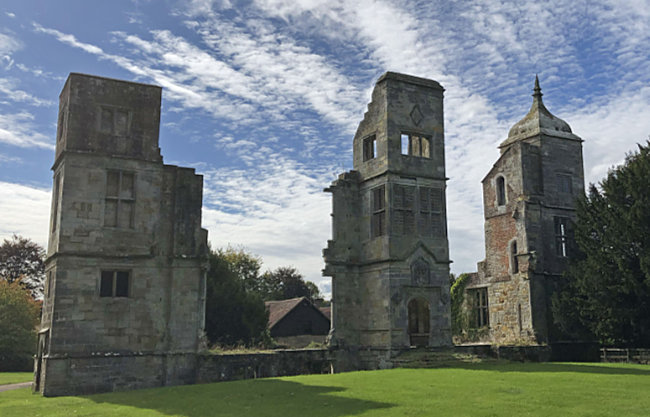
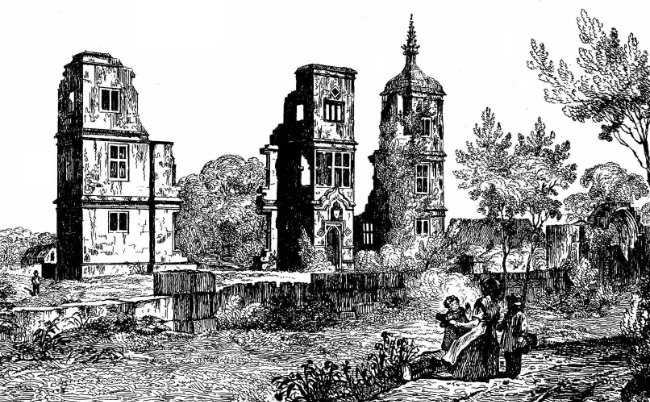
About a week ago the episode of the BBC's Secret Sussex featuring me talking to Simon Furber about the Brambletye ruins was put online. I believe it will air on the radio sometime in February but you can listen to it now here.

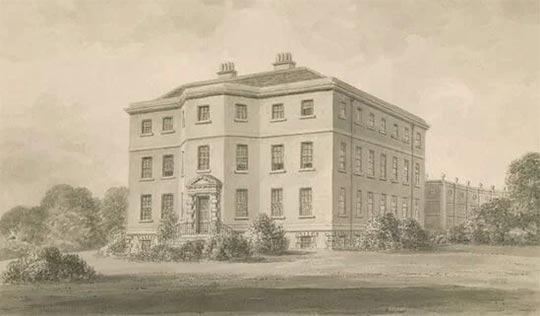
It's short and sweet so I didn't really get into the nuts and bolts of its history. We perhaps played up the mystery of its demise a little, which is all good, even though research shows when it came into the hands of the Biddulph family, in the 1670s, they focussed on their other properties and it just gradually went to ruin, with portions of it carted away for other local building projects. But the intrigue remains!

I also mention a painting of the ruin from 1782 - that's the date you see everywhere for it, but I've subsequently pinpointed it more accurately to 1773. In the wake of this interview, fresh with all my research, I wrote up my big Genealogy of Brambletye piece, where you can learn much more about its thousand-year history.

Thanks to Simon Furber for the interview on a very pleasant day and his magical editing to make it all sound good, and also to BBC journalist Fiona McCarthy for the contact request and organisation. Check out the Secret Sussex website for much more! Update: There is also a supporting article over on the BBC News website.

posted 10.01.26 at 3:18 pm | permalink at Webbledegook |

A Genealogy of Brambletye

Wednesday 29 October 2025
A few weeks ago I was interviewed for an episodes of BBC's 'Secret Sussex' on the old ruin of Brambletye House at Forest Row. Yes, this is the same 'Brambletye' that features in the current Julius Chancer comic I'm working on.

In preparation I had to brush up on my research and get it all in order - though in the end I didn't need to call on much of it as the push was more towards the atmosphere and feel of the place. But as part of the process I used my notes and expanded it into a full-length article, A Genealogy of Brambletye, looking at nearly a thousand years of history of this interesting Sussex manor.

It starts with the Norman conquest and Domesday, and follows the knights, earls, lords, ladies and gentry as they experienced Agincourt, the Wars of the Roses, the Reformation, the Civil War, the Restoration, then into its ruin in the 18th century, and under the ownership of bankers and solicitors into the 19th and 20th centuries and beyond.

You can read A Genealogy of Brambletye here.

posted 29.10.25 at 8:09 pm | permalink at Webbledegook |

The Hodgkins of Staffordshire

Friday 8 September 2023
I have an article in the latest issue of Romany Routes (vol. 16 no. 4), on the Gypsy Hodgkins, Hodgkinson and Hodgkiss families of Staffordshire (Cheslyn Hay, Uttoxeter, Rugeley, etc.)

I will publish the piece online once the magazine has been out for a bit. Update: it can now be read online here.


posted 08.09.23 at 8:11 pm | permalink at Webbledegook |

Two Africans in 19th Century Britain

Thursday 10 August 2023
Anyone embarking on historical research will know the danger, and thrill, of getting sidetracked by little mysteries and tidbits that are tangential, or even totally astray from what you're supposed to be looking at. Sometimes it's best to ignore these glittering threads, but other times the pull is just too strong, and you suddenly find yourself with a new little side project, drawing you further and further in. This is about two of those instances where I researched men with an African origin living in 18th and 19th Century Britain, Cyrus Hamilton and William Dobson.

Cyrus Hamilton (c.1764-1825)

The first showed up during some family history research. I was looking into my Staffordshire Hodgkins family and found myself in the baptism book for St. Michael and All Angels, Penkridge, where there was a baptism on 7 November 1779 for "William, son of Ann Hodgkins". But my eye was caught by the entry directly above, on the same day, for one "Cyrus Hamilton, an African Negroe". I was immediately intrigued - there were reportedly about 10-15,000 black people living in England in the latter half of the 18th century (largely in London), but what was this gentleman's story, and how did he end up in Penkridge?


Baptism of Cyrus Hamilton, Penkridge, 1779

Cyrus was already around 15 or 16 years old when he was baptised (if his age recorded at death is correct), and was said to have been brought to England by a 'Lady Hamilton'. Within two or three years he went into service as butler to Sir Edward Littleton of Teddesley Park, MP and 'country gentleman' (1727-1812).

In 1809 Cyrus married Susanna Barnes in Birmingham and they had two children in Penkridge, Louisa in 1813, and Edward Moreton in 1815 (the name Moreton came from Sir Edward's brother-in-law, Moreton Walhouse, whose grandson inherited the Littleton estate in 1812). Cyrus died in February 1825 and was buried at Penkridge, in the same church in which he'd been baptised. With his death, a small annuity from Teddesley Hall ended, putting some financial strain on his surviving family.

His wife, Susanna, went on to a new relationship with an engine fitter, Joseph Yates, with whom she had a son, Thomas, who sadly only lived a few months. She died in 1865, aged 78. Son Edward Moreton Hamilton married Esther Jane Brown in 1841 - they may have gone to the US in 1851 and maybe also had family there - I have not yet been able to follow them up.

Daughter Louisa seems to have provided three grandchildren for Cyrus - all from an unknown father who she claimed to have married in France - John (b.1844), Emily (b.1846), and Thomas (b. 1849). Thomas would marry and have at least seven children, continuing Cyrus's family into the 20th century.

The Staffordshire Record Office contains some interesting papers in the form of letters from Louisa to the 2nd Lord Hatherton at Teddesley, suggesting her late father had actually been adopted by Lord Littleton, and that she had leant a large sum of money to Lord Hatherton's father. The letters were an attempt at financial relief and, despite her stories not being believed, she was awarded a small allowance to help with her rent and debts.


Teddesley Hall, Penkridge, in about 1841

Perhaps the most intriguing aspect of this story is the identity of 'Lady Hamilton', the discovery of which might provide an origin for Cyrus himself.

The title of 'Lady Hamilton' immediately conjures up the famous mistress of Horatio Nelson, Emma or Amy Lyon - but she was not Lady Hamilton until 1791. Interestingly, she was also mistress to Charles Francis Greville (her future husband's nephew), whose father had sold his Penkridge lands to Sir Edward Littleton in the 1740s.

Nelson was acquanited with another Lady Hamilton, the wife of one William Leslie Hamilton Esq., Lady Isabella Erskine (daughter of the 10th Earl of Buchan), also known as Lady Belle. She is of particular note as Louisa Hamilton claimed her father was "the natural son of Lady Bel Hamilton". A Lady by way of her father being an Earl, she became a Hamilton in 1770 when she married William in Speldhurst, near Tunbridge Wells.

Immediately after their marriage, the Hamiltons travelled to the West Indies, specifically St. Kitts, where William was Speaker of the House and later Attorney-General of the Leeward Islands. They stayed for a while on the Olivees estate, complete with its enslaved population, and "belonging to Hamilton's sister". This would be Catherine Hamilton, married to Peter Matthew Mills who had inherited the estate from his father (killed on the island in a duel in 1752).

Lady Belle returned to England in July 1779, four months before Cyrus's baptism, due to increasing insecurity from the American Revolutionary War (the French would take St. Kitts in 1782). Her husband followed in the next year but died within days of his return, and their wealth was devastated when the ship carrying many of their belongings was captured by the French. After a second marriage, in 1785 to the Reverend John Cunninghame (15th Earl Glencairn in 1791), she died in Boulogne in 1824.

Lady Belle has another interesting, if obscure, link with her more famous namesake, Lady (Emma) Hamilton, in that both Lady Hamiltons were muses of the artist George Romney (1734-1802). Emma appears in a number of beautiful and sensual portraits by Romney, apparently sitting for him over 100 times. Lady Belle was Romney's subject on several occasions recorded between 1777 and 1791, "as Lady Isabel Hamilton she sat many times ... as Lady Bell Cunningham twice, and twice as Lady Glencairn".


Lady Belle Hamilton painted by George Romney in the 1780s

Depending how accurate Louisa was with her 'Lady Bel' comment, more research may uncover a more dependable link with Isabella (or her husband, a more likely candidate with stronger associations with the Caribbean) and some other aspects of Cyrus's history (the Littletons, for instance). Perhaps there is another 'Lady Bel' out there besides the one I've found and speculated on here. There are certainly more Lady Hamiltons to find - there is Lady Marianne Hamilton (1737-1802), or Lady Cassandre Agnes Hamilton (1741-1821) or maybe even Lady Louisa Hamilton (d.1777) dying just before Cyrus's baptism and with the same name as his eldest daughter. Isabella Erskine looks very intriguing - and I think most likely - but the case remains open.


Basseterre on St. Kitts in about 1808, a place of origin for Cyrus Hamilton?


William Dobson (1831-1887)

I came across William while doing research for my Second Anglo-Afghan War studies. I was examining a photo of Sergeants of the 72nd Highlanders at Sialkot, India, in 1878, and one man in particular stood out - quite obviously, and unusually, a man of African descent.

A bit more digging showed Sergeant 218 William Dobson did not serve in the Afghan war, and was actually discharged from the army as medically unfit (due to years in the harsh climate of the Indies) not long after that photo was taken, in June 1878. He'd given many years of service, enlisting at Edinburgh in 1858 before being sent to his regiment for the aftermath of the Indian Rebellion. He rose up through the ranks, gaining Corporal in 1863 and Sergeant in 1865, serving in India, Ireland and the UK. His conduct was reported as "very good" and he received the Long Service Good Conduct medal with gratuity in 1876.


Sgt. William Dobson in the distinctive trews of the 72nd Highlanders, at Sialkot in 1878

William was actually born in Edinburgh, in 1831, to an African father (also William Dobson, a gentleman's servant or butler) and a (presumably) Scots mother, Mary Flockhart. He was one of six siblings of which three certainly died young, and no trace can yet be found of the other two.

In 1851 William's father was a widow (with no children present), and manservant to John Kennedy, a retired Writer to the Signet. The census records he was born in Africa, a British Subject, and was working alongside one Margaret Gordon, the household cook. She was almost half his age (born, in fact, just a few weeks after his first marriage), but they would wed two months later and go on to have five children, half-siblings to Sergeant William Dobson, though only two survived into adulthood. The 1861 census gives more detail on William senior's origins, with his birthplace recorded as Sierra Leone, Africa, a Naturalised British Subject.

William's birthdate of around 1807, and birthplace as Sierra Leone is interesting, as in that year the British government abolished the slave trade and the following year made Sierra Leone a Crown Colony, with Freetown as its capital.


The marriage of William Dobson and Mary Flockhart in 1827, with William's ethnicity noted, but no comment on Mary

William senior would die in 1863 (just a couple of weeks after his six-year-old son, Harris), aged 56, while his second wife would live until the age of 68, dying in 1897. One of their surviving children, Henry Edward Dobson, would live until 1930 (he did not marry).

William junior's good army conduct was not necessarily a reflection of his earlier life, for in 1852 he was sentenced to seven years transportation for house-breaking and spent three years at Portland Prison in Dorset. But in 1855 he was involved in an incident in which he helped one of the warders who had been attacked by another prisoner wielding a pick-axe during quarry labour, and was granted early release. It seems likely these events may have had some influence on William enlisting with the army some two-and-a-half years later.


Prisoners at Portland endure hard labour while a warder watches on, 1863

While still in the army, in July 1866, William married Ann Prescott in Edinburgh (the 72nd had arrived there from India in February), the daughter of a gun polisher from England, though they'd both lived on Jamaica Street in the 1850s so perhaps knew each other already. By this time Ann was mother to an 'illegitimate' child, Jane Prescott, but she and William would have seven other known children, in India, Ireland and Scotland, four of whom would reach adulthood and have families of their own.

Unfortunately the end of William's tale is a sad one. On 9th February 1887, William's wife of 21 years died from disease of the kidney, heart and liver - as a soldier's wife, bearing children in the Subcontinent, she'd had a very hard life indeed - she was only 40 years old. Two weeks later, William (who'd been working as a maltman) took his own life in a rather violent manner, cutting his throat with a razor; he was 60 years old. His eldest surviving child, Thomas, was 17, and his youngest, Sophia, was just 7. Sophia would live a long life, dying in 1958 at the age of 79, and leaving behind family of her own.


Freetown, Sierra Leone, in about 1850

It seems important that these otherwise little-known Black Britons should have their fascinating stories researched and told, and I have added both families to WikiTree, which cites many of the sources used (Cyrus Hamilton | William Dobson).

Note: I've since seen that Sergeant William Dobson is recorded elsewhere on the internet, for instance on a handful of Black Britains and Black History Month projects. The biographies there state he was born in South Africa with his mother working for a British army family and that he died in 1898. I believe the source for this is a 1900 edition of The Christian Express, and it does not line up with my own research above - which I feel quite confident in and is well-sourced - but I'm happy to view any evidence to the contrary.

posted 10.08.23 at 7:29 pm | permalink at Webbledegook |

Solving Helen Clark of Scone

Monday 24 July 2023
While the main focus of my research in the Ewing line has been the brick wall of my 5xg-grandfather James Ewan (aka Ewing), his wife, Helen Clark, has also been stuck at a dead-end for the more than two decades that I've been doing family history.

James and Helen married at Scone in Perthshire on 7 July, 1793. A couple of years ago I made more of an effort to look into Helen, starting - in the absence of anything else - with the fact that a grandchild of hers was named Thomas Clark Ewing (another was Helen Clark Ewing), quite likely named after a relative of Helen's - her father, perhaps, or a brother?

With Helen being 'of Scone' it seemed sensible to investigate any Thomas Clarks in the same locale, and indeed one (and only one) does pop up, namely Thomas Clark who married Margaret Wilson, at Scone, in 1800. He appears on the 1841 census as a merchant in New Scone, aged 65, giving a birthdate of around 1775. Helen was in Dysart, in Fife, at this time, with her age given as 75. Remembering that ages in the 1841 census could be rounded down to the nearest 5 years, this would give Helen a date of around 1765.


Old Scone Church - in New Scone

A search for Helen Clarks (Clarke/Clerk/e) born in Perthshire between the years 1760-1775 gives five candidates. Of these only one family also had a Thomas, these being the children of Adam Clark and Elspet Robertson. Also of interest is the fact that their birthdates fit the 1841 census the closest - with Helen baptised in 1766, and Thomas in 1773.

While I did look into the other families, it is that of Adam and Elspet that keep coming up with stand-out data points. There are five baptisms on record to this couple, the first two at Scone (Innerbuist), and then three in St Martins (Durhamfield). Helen and Robert appear in the record next to each other under "some deseenters children", baptised in 1766 and 1768 respectively. Thomas Clark's 1846 Will gives instruction to leave £10 to the Session of the United Associate Congregation of Scone, the same seceder's denomination under which James Ewan and Helen Clark had a number of their children baptised, in Perth.

James Ewan and Adam Clark appear on the same page of the 1797 Horse Tax Roll of Scone - James at Parkfield of Limepotts, and Adam at Pikestone Hill (now Pictstonhill), neighbouring farms less than a mile and a fifteen-minute walk from each other.


maps showing Limepotts and Pictstonhill farms, 2023 (top) and 1866 (bottom, closer-in)

While there are several factors that point to Helen being the daughter of Adam and Elspet Clark, there is another that throws a spanner in the works. There is another Scone marriage involving a Helen Clark - the 1789 marriage of Helen Clark, of Scone, and Henry Low, of Kinnoull. This Helen could also be a candidate as the daughter of Adam, so how to differentiate?

There are several difficult things about this Clark/Low union. I could find no children for the couple, and no deaths. Henry Low of Kinnoull is a fairly unique identifier, and just such a person can be found, in 1791, marrying a Helen (or Nelly) Hutton in Perth (married by a Burgher dissenting minister, rather than the Anti-Burgher tradition of the Ewans). This marriage had more evidence of a life - children, newspaper mentions, and deaths for Henry and his wife in 1828 and 1837.

So what happened to Helen Clark from the 1789 marriage? A closer look at the record may provide the answer. On page 189 of the Scone Old Parish Register, the Low/Clarke union is listed among fourteen other marriages - every one of those entries mentions that the parties were either "contracted, duly proclaimed and married" or "contracted, proclaimed and married". The exception is Henry Low and Helen Clarke, which states, "November 9 Henry Low in Kinnoul Parish & Helen Clarke in this Parish were contracted and duly proclaimed". This may be a clue that, while the banns was proclaimed, the marriage did not go ahead. So perhaps the same Henry Low would go on to marry Nelly Hutton just over a year later, and the same Helen Clark would go on to marry James Ewan in the same church, almost four years later.


Helen Clark marriage entries 1789 and 1793 - the same Helen?

There are other aspects of which to be careful. Just because there is no record, it doesn't mean there is no person - so while there only seems to be one Scone Helen Clark, there could be another whose baptism does not exist in the records. Also there is a Monumental Inscription recorded for Adam Clark, who died at Scone in 1799, which suggests he had five children who "died in childhood" (though it's not clear from the transcription, this could actually refer to the children of his son, James). One of these children could have been Helen, unrecorded.

While it would be great if Helen had named one of her children with the less common name of Adam, or Adam himself had left a Will with a mention of a married daughter named Helen Ewan (some of his children did leave Wills), on balance, with the other evidence of the names, birthdates, geographical proximity, and religious connection, it seems a very strong likelihood that Helen Clark, who married James Ewan in 1793, was the daughter of Adam Clark and Elspet Robertson. Furthermore, Adam, born in Errol in 1733, was the son of Robert Clark and Elspeth Jackson, taking Helen's probable line back one generation further.

As usual, I invite discussion and further evidence for or against this theory from fellow researchers - please feel free to get in touch.

posted 24.07.23 at 3:55 pm | permalink at Webbledegook |

Climbing the Haplotree

Thursday 27 October 2022
Y-DNA is very slow to mutate, which is what makes it so useful in analysing your genetic history. But equally slow are updates and new information. With atDNA (autosomal) there are new genetic matches every day, most of them very distant of course. With Y-DNA, I've just had my first update in three years.

I'd originally done a basic Y-DNA test with FamilyTreeDNA back in 2018, analysing just 37 markers. It disclosed my haplogroup as R-M269, which wasn't very revealing - it's the most common group in Europe and is estimated to be between 4000-10000 years old.

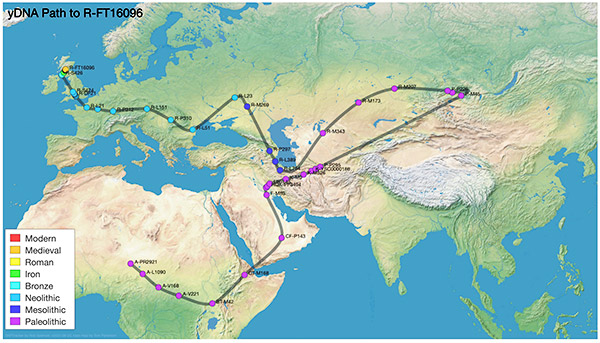
I actually had more details than this from a couple of other previous DNA tests that included Y-results along with their atDNA analysis. LivingDNA put me into R-L21 with a subclade of R-S3058, and 23andMe gave me R-S190, which was the deepest result. Putting my Ancestry DNA results through the MorleyDNA Predictor also concluded R-S190. The line of descent goes like this ...

R-M269 > R-L23 > R-L51 > R-P311 > R-P312 > R-L21 > R-CTS241 > R-DF21 > R-FGC3213 > R-S3058 > R-S424 > R-S426 > R-S190

S424 and (particularly) S190 are markers that define a unique family line known as the Little Scottish Cluster (LSC). Anyone who tests positive for these haplogroups shared a common ancestor from somewhere between 1000-1500 years ago in southern Scotland, perhaps around the Perth and Stirling areas. As this was a time before the adoption of surnames, there are a variety of surnames within the LSC (see this paper (PDF) by Steven R. Colson, 2007).

If you really want to get deep into your haplogroup subclades, you can take a 'Big-Y' test, but as this was beyond my finances, I thought I'd never do it, and I was happy enough knowing what I already had. But then my 50th birthday coincided with a generous sale at FTDNA, and I went for it - the Big-Y700 test.

The results of this got me much deeper into the branches, with my new haplogroup terminating at FT16096 ...

S424 > S426 > R-S190 (LSC) > FGC3215 > ZZ23 > Y12464 > Z17998 > FGC3101 > Y16002 > Z17999 > FT16096

Out of just over 400 men who have tested and signed up to the LSC project (not all with Big-Y tests) this put me in a sub-group of about a dozen individuals, though they tested positive for various sub-branches which I didn't, it put my Ewing line out in its own little twig.

So that's where I've been for the past three years until a recent new batch of Big-Y tests were analysed and I was joined on my little FT16096 twig by another individual. Now there's someone to compare me with, the subclade can be better defined. A variant that was once unique to my Ewing line is now shared and can therefore be identified, resulting in a new haplogroup terminus, namely FT173826 - a clade defined by having a derivative A at position 6869996 on the Y-chromosome, instead of the ancestral G.

The common ancestor of this new haplogroup most likely dates to around the year 1350, it could be older, but could also be as recent as 1600 or so. But perhaps the most interesting thing is that this other tester also has the surname of Ewing, suggesting my surname could have been fairly consistent for quite a number of generations.

As a side-note, thanks to the results of the Ewing family DNA project, I know I am not at all closely related to the majority of Ewings there, who are largely descended from Scots-Irish Ewings who left the Emerald Isle for the US a few hundred years ago. This is not surprising - the best and most accessible Y-DNA testing company at present is FamilyTreeDNA, who are American, and as most of their customers are American, it is American Ewings who make up the bulk of the Ewing project.

These Ewings belong downstream of the R-M222 haplogroup, which means our 'common ancestor' clade is R-DF13, dating to around 4,400 years ago. At least I can now definitively say I am no relation to JR and Bobby Ewing from Dallas, the bane of my life in the early 80s! But perhaps it also means I would not strictly be a member of Clan Ewing, said to descend from Ewen of Otter. No Ewing tartan for me! (I jest, though actually I wore McLachlan tartan at my wedding twenty years ago, with a Cameron pin).

So, partly for that reason, at the moment the Little Scottish Cluster holds more immediate interest for me. You can look at a heat-map of the surname Ewing in the UK, and compare it with the general route of migration for my own haplogroup line. My earliest known ancestor, as of this writing, is James Ewan (aka Ewing), born probably around 1765 and living near Perth, shown with the little star on the map below (see my Ewing family history here). It all seems to add up rather neatly (though I'm sure the reality is not quite so tidy as it looks!).

One aspect of Y-DNA I find endlessly fascinating (honestly!) is the short tandem repeats, or STRs, that count the number of repeating alleles at specific locations in the Y chromosome to help pinpoint identification. For instance, a must-have characteristic of the Little Scottish Cluster is having an STR value of 9 at position DYS 590 (TTTTG repeated 9 times). Only 1% of R1b men have 9 here, where it is usually 8 (most members of the Ewing project have 8). And I seem to be unique, at the moment, within the LSC in having a value of 12 at DYS 393, where the majority has 13 (91% of R1b men have 13).

Not a lot can be concluded at the moment, and answers would only really start to come if more Scots Ewings and Ewans did Y-DNA tests. This would doubtless enlarge the tree and help to map Ewings in the LSC, and would also likely reveal other groups, possibly relating to McEwans, MacLachlans, and other Eoghan-related surnames. I'll look forward to the next update ...

posted 27.10.22 at 4:45 pm | permalink at Webbledegook |

Who Were Donald Cameron's Parents?

Sunday 14 November 2021
This piece is a summary of information concerning some of the leads and dead-ends in the search for the parents of Donald Cameron (c.1810-1887), husband of Catherine Campbell, and one time church officer for the village of Clunie in Perthshire. I've been researching the Camerons for over two decades, and this aspect can get quickly bogged down in detail and diversions. So this is a bit of a rush through to discuss the outline of where I am so far (as of Nov 2021), and areas where more needs to be done - in the hope it will be useful to others who want to help solve this genealogical brick wall.

The starting point is Donald's 1887 death certificate, which records his parents as being John Cameron, farmer, and Ann McDonald. Case closed! Well, not quite ... there is no baptism record for a Donald Cameron born to such parents, and no such parents coinciding with the time and place for our Donald or any possible further family. The information was provided on the death certificate by Donald's son-in-law, Charles McGregor, and we might presume it could have been confirmed before-hand by Donald's widow, Catherine, who would survive him by another 19 months.

A number of Cameron family genealogists have attributed various parents to Donald, and I'd like to go through these to see if they stand up to falsification. But first, a couple of basic facts: Donald Cameron appears on census returns for 1841-1881 with a consistent place of birth, Little Dunkeld, and the year focusing on 1810, give or take a year or so - if accurate.


Death certificate of Donald Cameron

There are a handful of Donald Camerons born and baptised in Little Dunkeld who have been associated with our Clunie Donald. The earliest is Donald born to Donald Cameron and Janet Black of Tomgarrow in June 1807. But this Donald can be identified in the census returns, living for a while with his widowed mother, then as a single man into old age, dying at Tomgarrow in 1897 - so he's not our Donald.

The next one is interesting thanks to the mother's surname, Donald Cameron born at Little Trochrie in 1808 to Alexander Cameron and Clementina McDonald. But although these parents appear on many trees for Clunie Donald, they can be discounted too - their son married Catherine Duff in Little Dunkeld in 1840, and he died there in 1881.

We're taken quite a way out of our expected birth time-zone for the next possibility, namely Donald Cameron born at Tomgarrow to Donald Cameron and Lilias Duff in 1816. This Donald, too, can be crossed off the list as records show he married an Ann McDonald in 1851 and died in Pitlochry in 1899.

This one shouldn't really be a candidate, but I have seen him on a tree or two - Donald Cameron born in 1825 to John Cameron and Catherine McNaughton, again at Tomgarrow. If this were correct then our Donald would have married at the age of 12. Anyway, this Donald can be accounted for in a rather macabre way - in 1858 he went insane and murdered his two-year old son, then died in Perth prison from cholera in 1866.

It's interesting that so many of these Little Dunkeld Camerons are of Tomgarrow. This tiny village does not exist any more, but was thought at one time to be the home of tens of Cameron families, with the tale that in times long past the village was famous for its sword-makers. Certainly Tomgarrow should be considered a possible place of origin for our Donald, especially with the Little Dunkeld parish register being "not very regularly kept" according to records.

Another place of interest would be Caputh, where Donald and Catherine were resident and married in 1837. There is one Donald Cameron here that is sometimes picked up - the son of John Cameron and Catherine McDonald, but he was born in 1795 and for that reason remains an outsider in our list of candidates. It should be noted that the Caputh John and Catherine are not the same as the Inverness couple with the same names, the first married in 1792 and the latter in 1807, though they are sometimes amalgamated as their marriages are hard to find (search for Ketrin and Ketherin rather than Catherine).

A couple with the same names had a 'lawful son', Allan Cameron, in Clunie in 1811, and a Peter Cameron was also born there in 1829 to similarly-named parents - but these are different couples as Peter was a 'natural child' (illegitimate).

Some researchers have discovered a Donald Cameron born to a John Cameron and Ann McDonald and attributed them as our Clunie Donald's parents. The birth date is not quite right - with a likely baptism record of 1817 and census returns indicating the early 1820s. Also his place of birth is Sleat, Inverness, a long way off. But this Donald did actually die in Perthshire, and, remarkably, does have a connection to our Donald - though he is not our Donald.

John Cameron and Ann McDonald appear to have married in Inverness in 1807, and I can find only two children that may be theirs - Donald (1817) and Lachlan (1821). Donald went on to marry Helen Stewart in Blairgowrie and they had seven known children, including a Daniel Cameron in 1859. This Daniel married Sarah Cameron in Largo in 1891 - and this Sarah is a granddaughter of our Clunie Donald, through Margaret (born Caputh in 1841). Daniel and Sarah went on to have seven children of their own before emigrating to Canada around 1930.


Area map highlighting Tomgarrow, Inver, Little Dunkeld, Birnam, Caputh and Clunie

That covers the majority of candidate parents most often cited from the old parish records, though I've decided not to include my notes on various other theories (illegitimacy, Ann McDonald remarrying, etc.). But let's look at some other families of interest I've found through other routes ...

In 1911 Agnes Craig Wallace, one of Donald Cameron's grandadughters, who ran a confectionary shop in Birnam, Little Dunkeld, had as a boarder the daughter of a Dundee medical practitioner, one Alice Jane Gray. Alice was a music teacher, and while she may have just been lodging with the Wallaces, it seems she stamped some kind of impression as Agnes gave birth to a daughter six months later who she named Margaret Jean Gray.

What was Alice Jane Gray to Agnes, was she a relative? If we look into her family history we find she was descended from two Cameron families of Blair Atholl, Perthshire - that of Finlay Cameron and Christina McDonald (on her maternal grandfather's side), and of Alexander Cameron and Margaret McDonald (on her maternal grandmother's side).

Finlay and Christina had a son, Donald in 1799, and he can be accounted for as dying in Edinburgh in 1870. Of more interest is Alexander and Margaret. Our Clunie Donald named his first son Alexander (it's perhaps notable, or not, that he didn't name any of his known children John), and his second daughter was Margaret (the first was Ann, so that may have significance).

Alex and Margaret Cameron had a son, Donald, in Blair Atholl in 1807 - close enough to the date we're looking for and I have not yet been able to find any trace of him after his baptism. The splinter in the theory is his birthplace, as Clunie Donald is very insistent he was born in Little Dunkeld, not Blair Atholl (20 miles north). If these Donalds were the same person, then that would make Agnes Wallace (b.1869) and Alice Gray (b.1868) second cousins - they also lived in the same quarter of Dundee through the 1880s and 90s.

It's a tenuous theory with not a lot to back it up - but then Agnes Wallace was partially responsible for me breaking down the Catherine Campbell brick wall a couple of years ago, after researching her husband's first wife, Sarah Sim. Many family connections seem to gravitate around Agnes.

Agnes Wallace can also lead us to another theory, this time discovered through her younger brother, James Wilson. When he married, at age 30 in Birnam in 1906 to Jessie Campbell, one of the witnesses was James Crockett. James was the son of Frank Crockett and his wife Janet, and a family story involving visits to her claims that she was "a relative". This becomes more interesting when we find that Janet was indeed a Cameron, the daughter of Alexander Cameron and Helen Anderson, and born in Caputh in 1864.

The Crocketts lived in the Little Dunkeld village of Inver (later at Niel Gow's Cottage), and that's where Alexander Cameron died in 1904. His death certificate reveals his parents to have been John Cameron, soldier, and Ann Auld - names tantalisingly close to our Clunie Donald's John Cameron and Ann McDonald (note the ald/auld).

Unfortunately nothing can be found of this couple. The military connection is interesting because Donald married Catherine Campbell, the daughter of a sergeant in the 42nd Foot - there is a John Cameron of Dunkeld also in the 42nd Foot from that era - but there were, as we know, a lot of Camerons from the area at that time.

Alexander was born in Caputh in 1826, some years after the supposed birthdate of Donald, and 11 years before he was married in the same place (Alexander would marry there in 1852). Another link of curiosity is that while Agnes Wallace and her husband ran the sweet shop in Birnam, Janet Crockett's sister-in-law, Helen Cameron, ran one in Dunkeld, less than a mile away across the Dunkeld Bridge. I personally think this is one of the strongest leads for Donald Cameron's family.


Dunkeld and Birnam joined across the Tay in an aerial photo from the 1950s

All these historical whispers leave fairly loose ends and nothing at all concrete, but do seem to have at least some significance worth keeping in mind. The last strand I'd like to look at is DNA, and with such a lack of records I feel this perhaps offers the most hope for an answer to the problem of Donald Cameron's parents.

Currently I have 13 Cameron DNA matches who I can definitley place in the known Donald Cameron/Catherine Campbell family, but there are a handful of less certain matches that contain Cameron families, with a couple worth looking into.

One of these has a John and Alexander Cameron born at Little Dunkeld in 1810 and 1813, right in our zone of interest. Their parents were John Cameron, carpenter, and Catherine Kennedy, resident at Tomgarrow. Confusingly, this turns out not to be the Cameron hotspot of Tomgarrow at Little Dunkeld, but a place some 20 miles to the west in Kenmore, where their first son, William was born in 1806. The Little Dunkeld births were at Ballinrich, a farm on the banks of the River Braan. Not much else stands out from this family in relation to our mystery. The family mainly stayed in Kenmore, with son John becoming a teacher and moving to Argyllshire.

The most fascinating DNA link contains no Cameron name at all. I have about 15 matches, a handful quite meaningful (28cM), with Isle of Sky ancestry - notably Lamont - that emigrated and settled in Prince Edward Island, Canada c.1803. The Cameron connection exists because these matches are shared by at least four of my definite Cameron cousins, with our common ancestors being Donald and Catherine Cameron.

I've spent many months looking into this connection with no obvious linking point as yet. It centres on shared DNA in chromosome 13 (with over 70 matches so far) and brings in a number of other Scots families as well as the Lamonts, including McDonalds, McLeods, McGregors, McLeans and McLellans, among others ... it would be another article in itself to try and present it all. [Update: I have now written this article, which you can read here.]

While these matches could theoretically link to Catherine Campbell's forebears, I managed to break down her brick wall a couple of years ago (see Finding Mrs Keir) and her family points largely to Caithness, which leans towards the likelihood of the match linking to our unknown Donald Cameron parents, perhaps the "McDonald" mother. Maybe Donald was illegitimate, or his mother came from outside of Perthshire, and keeping an eye on this DNA puzzle could well be the key to any future breakthrough, and I'd be especially interested to hear from any fellow Cameron descendants who have DNA links to Prince Edward Island in the early 1800s.

I present this little article as a waypoint in my research (all errors my own, please feel free to correct anything), and to share the load with my fellow Camerons in the hope that an answer is somewhere out there. We'll keep digging!

posted 14.11.21 at 3:05 pm | permalink at Webbledegook |

The Drowning of John Birrell

Thursday 18 March 2021
Twenty years ago, early on in my family history research, I came across the name of my 4xg-grandmother, Margaret Lonie, otherwise known as Peggy with her full surname being Auchterlonie.

There was no sign of a husband with her in the 1841 census of Anstruther Wester, where she lived with her two children, and the 1851 census revealed she was a widow. Through the records of the Fife Family History Society I soon found out her husband, John Birrell, had died by drowning in July 1840 - just two years after they were married - the only details being that he was a ship's carpenter, and the locations of the accident ('River Mersay') and his burial ('Stormount').

The only River Mersey I knew was at Liverpool, and the only Stormont I knew was in Belfast - places separated by 140 miles of Irish Sea, but perhaps making sense for a ship en-route from England to Northern Ireland.

Regularly over the next 20 years I would check resources and newspapers to try and uncover any mention of the drowning of John Birrell, with no luck. The closest I came was a boat swamped on the Mersey and in which two of the four mechanics on board were drowned - no names were mentioned, but the date was off of Birrell's recorded death by just two days.

I probably hadn't done a 'Birrell check' for about three years when I decided to try again a couple of days ago, and this time I hit the mark. In that three years, the British Newspaper Archive had added the Shipping & Mercantile Gazette to their library, and in this publication was the following story, syndicated from the Montrose Review:

"MONTROSE - July 24: ... two men belonging to a Montrose vessel, the Mars, Captain Younger, last week met a watery grave. The vessel was then lying at Fleetwood, in Lancashire; and the men, whose names were John Burrell and John Menzies, having gone ashore on Tuesday night, were returning in a small boat, early next morning, when they were drowned. The boat was picked up next day, five miles from the vessel; and the bodies of the unfortunate mariners were also found. Burrell was a native of Anstruther; Menzies, of Montrose, and has left a widow and small family."

The date of death and his place of origin, Anstruther, are correct, though a couple of other details seem odd. Fleetwood is about 30 miles north of the Mersey, so either the place of drowning is not right, or they went for quite a trip. The burial at Stormont makes sense as the next destination of the Mars was Quebec, though the only report I can find so far seems to indicate it sailed from Fleetwood on the 23 July, whereas John's burial is recorded as the 17th. Hopefully, with these new details, I'll be able to get a clearer picture sometime soon.

John was just 22 when he died, but managed to have two children with Peggy (who lived to 79), both of whom would go on to have families of their own. Son Andrew married in 1858 and had two sons, one a school master, the other a soldier and then shale miner, both producing families of their own. The other child, my ggg-grandmother, married in 1859 and had 12 children, a number of them successful in Dundee-based businesses, and most surviving to have families of their own as well.


I visited the grave of Peggy Auchterlonie, at Crail, in 2002 (her actual age was 79)
posted 18.03.21 at 12:59 am | permalink at Webbledegook |

Who Edwin Cole isn't ...

Wednesday 2 December 2020
A few years ago I started to collect postcards by the Shrewsbury artist Edwin Cole (1860-1941) published by Wilding & Son. During my searches for more postcards, and even some originals, I'd often come across art that claimed to be by Edwin Cole but didn't quite fit his profile.

Part of the problem is my own Edwin Cole webpage - with, for instance, ebay sellers misidentifying the signature on the art and then Googling my page and copy-pasting the info on the artist they think they're selling. In all the examples I currently have, Edwin Cole always signed his full name in caps, and often also included the year. Here are some examples from between 1905 and 1925.


Edwin Cole signatures 1905-1925

He also seemed to work exclusively in watercolours for his paintings, and the scenes are nearly all landscape subjects in and around Shrewsbury - but I wouldn't exclude other mediums and subjects coming to light - he was versatile, working with stained glass, metal and wood.

Also coming up for sale, often under the name 'Edwin Cole', are two series of postcards titled the Kitten Series (including 'Miss Vanity', 'The Model' and 'The Destroying Angel') and the Artistique Series (featuring female portraits with epicene names such as 'Sandie', 'Billie' and 'Tommie'), all published by the Pictograph Publishing Co. of London in the 1920s.


Pictograph postcards by Edward Cole

These are not by Edwin Cole but by a Hackney-born artist called Edward Francis Cole. His signature is often 'Edwd Cole' (with a very small second 'd') so can be misidentified without care. Here are some examples - you'll note the long line coming from the end of Cole that was consistent throughout his career.


Edward Cole signatures

Edward was a poster designer before he joined the Surrey Regiment for the Great War, where he made a number of benevolent cartoons of his officers. He created art for the Pictographic postcards and went on to become a highly skilled commercial artist, later moving to and working in South Africa.


Artworks by Edward Cole c.1916-1950s

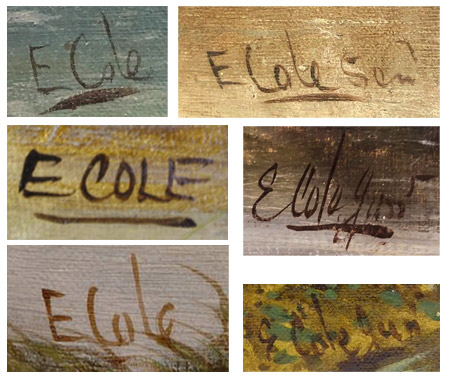
The vast majority of misidentifications concern a large number of original oil pantings being sold, not only through ebay, but also in auction houses both online and off, with the signature of E. Cole. Some of these, presumably later ones, are signed E. Cole Snr. or E. Cole Jun. (the latter not, as one ebay seller put it, because it was "painted in June").


Signatures of E. Cole (senior and junior)

The paintings are well-crafted (Cole senior slightly more professional, I'd say), and out of over 50 examples I've seen, all but a handful feature a country lane and a white-gated cottage (not always the same architecture), sometimes with a river or pond, sometimes with a girl walking in the lane, sometimes with a little stone bridge too. They are certainly nineteenth-century, but so far I have not been able to identify who the two E. Coles are - except they are not Edwin Cole of Shrewsbury.

One auction site has their art expert state "E Cole is probably a grandson of George Cole and a son of George Vicat Cole, both famous painters who made similar work". While the elder George Cole did indeed have a son called Edwin Cole, he was a mariner from the 1850s and my last sighting of him is in Jamaica at the end of 1880s where his Dutch second wife died. I doubt he was the artist, though he can't be fully ruled out just yet. Vicat Cole had four daughters and one son, Rex, also an artist. His daughter Edith Ivy, was probably not the 'E. Cole Snr' - most likely a male artist. But, certainly, the subject matter is thematically in line with that of the Vicat-Coles, including another son, Alfred Benjamin, so the family is worth exploring more fully.


Oil paintings by E. Cole

Finally, another name has been thrown in to the mix, that of Ethel Kathleen Cole (1892-1976), sometimes identified as the painter, mistakenly I think, of one or more of the above E. Cole pieces. I have not been able to find a definite sample of her work online. A webpage of Suffolk artists assigns two paintings to her, one with the usual E. Cole signature (almost certainly misattributed) and another that says 'Cole - Ethel Kathleen' on the reverse - likely not put there by the artist herself, and probably another E. Cole painting by the looks of it.

Part of her biography states that Ethel went to the Slade School of Fine Art, and there is a figure sketch attributed to her from 1912 on the University College London site, though it is signed K. Cole, and a contemporary newspaper article refers to her as Kathleen Cole. The UCL site, confusingly, says Ethel was American and that she died in 1934 after living in Derwentwater. This does not seem to be correct, as census returns say she was born in Beccles, Suffolk, moved with her family to East Grinstead, and worked as an art teacher later in life, dying in Lewis, a spinster, in 1976. An E. Kathleen Cole is recorded as exhibiting at the Royal Academy Summer Exhibition in 1931, 1932 and 1935. Again there appears to be the biographies of more than one candidate conflated.


Ethel's 1912 signature, and a signature on a 1930 sketch I spotted on ebay

The research I've done here is not complete, and I especially hope to eventually identify E. Cole senior and junior. I'll update this as any new information comes to light, but in the meantime I hope it helps to correctly identify what is by Edwin Cole of Shrewsbury, and what isn't.


The Welsh Bridge, Shrewsbury, by Edwin Cole (1905)
posted 02.12.20 at 4:30 pm | permalink at Webbledegook |
main (page 1 of 5)