


This blog began in 1997 as a single news page called Nucelus. In 2005, during a long wait to move into a new house, I decided to learn some php and MySQL and write my own blogging system, which became inkyBlog and which now powers this, my own Webbledegook blog.
Thank you to my brother, Murray Ewing, for help with some of the more challenging aspects!
George, born in 1898, was the third of four boys, sons of James Jervis, a steam roller driver, and Alice Mary Ecclestone. The family came originally from Staffordshire but moved to Epping in Essex around 1890. For the war George joined the 9th Battalion Essex Regiment and on 5th April 1918 the Chelmsford Chronicle reported him "seriously ill with gunshot wounds in the thigh".
While the 9th Essex were involved in an intense conflict on the 5th April, it is perhaps more likely that he was wounded at the end of March, probably during the severe fighting of the 27th around the town of Albert by the River Ancre. George died of his wounds at the British depot at Etaples on 8th April 1918. Just under a month later his parents received further devastating news when their second-eldest son, Clifford, was reported as wounded and missing. It turned out he had been taken prisoner and, happily, he survived the war.
Stewart John McHardy (also b. 1898) has had a brief mention before, in a post relating to the death of his cousin, Alexander Maxwell Smith (killed in April 1917). Both their fathers were killed in train accidents, Alexander's being struck down on the line outside Rosemount, near Blairgowrie, in 1927, and Stewart's falling from a train en route to Rosario in Argentina in 1916.
His father had moved out to Buenos Aires in about 1890 and, after starting out in farming, had graduated to the laying out of tennis courts and athletics pitches, later going into business as a sports outfitters and even branching into sales of Ford motor cars. Stewart had worked for his father, but a few months after his death he returned to the UK (he was born in Dundee) to enlist, arriving in London on the Highland Rover in October 1916 and joining the 7th London Regiment - 'The Shiny Seventh'. A year later he was commissioned Second Lieutenant and in early 1918 he was attached to the 2/19th London Regiment at Jerusalem. At the end of April they saw heavy action against the Turks at Es Salt in Jordan, and it was here that Stewart was killed in action.
See my family war memorial here.

Severely wounded men waiting to be moved from the front line in France (Illustrated War News, April 1918)


Also in that opening scene we see some of the building's interior - a bit of the hallway, the library, the collection room, and Sir Alfred's office. Later we see the breakfast room, which also made an appearance in The Secret of the Samurai, where I mapped out the room more properly. This made a big difference to the way I drew it and the way it came across in the strip - it had a much better sense of both space and place. You can read a bit more about that in this blog post - The Secret of the Samurai - Part 2. Another post on designing the environment can be seen here - Map Room.

This is all part of my learning process and a desire to make the world that Julius Chancer inhabits more realistic, or at least more believable. With this in mind, and having to show yet more of Sir Alfred's house in the next adventure, I have ended up going the whole hog and mapping out the entire building, both exterior and interior. A bit crazy perhaps, but now the setting is real to me and makes sense. (Some of it was hard to make sense of as I'd already drawn various rooms with windows in various places - but it all joined up in the end!)


I won't say any more than they've released, which is that it's coming out in September 2018 and contains four new expansions for the game which can be added separately or combined together. The set includes four character cards, 18 adventure cards and 10 terrain cards.
Here's Osprey's blog post, and there's a little more artwork shown over at ICv2, where they mention Spanish conquistadors, a mysterious mountain, new companions, and a dark curse.
Once again I had the pleasure of creating the artwork for Peer Sylvester's excellent game - and I can't wait to play the expansions myself!

The reaction ranged from calling Tommaso 'entitled' and 'arrogant' to solid support for his rant and empathy for his view. While there may have been a little truth to some of the criticisms (not including the ill-mannered name-calling) I could also sympathise - literally years of intensive work resulting in pitiful financial returns is why so many creators can't make a living from comics alone, or even spare the time to make them.
Of course the negative reaction to this view is because artists and writers are supposed to be grateful for even being able to touch the hem of a career in art, let alone get paid for it. There's still an attitude that such vocations should be done 'for the love of it' (as if you can't get paid for something you also love), even going so far, sometimes, as viewing any financial remuneration as a form of 'selling out'. Little understood among many outsiders is the fact of the increased burden on mental health that goes with doing something you are so passionate about, often resulting in an extreme love/hate relationship with the thing you're supposed to comfortably enjoy. Making comics is rarely a comfortable occupation.

It is true that no one is owed an audience. There's a market out there, and success in it can largely depend on whether you've made something that large numbers of people actually want to read. But first that market has to be made aware of the art in question and there are many stories of wonderful comics dying on the vine thanks to poor awareness or marketing. It's a challenge for both creators and publishers.
Thankfully, Tomasso's post, as well as opening a useful discussion, helped to heighten awareness of Spy Seal and resulted in an increase in sales, eventually leading to the publication of four issues and, in January 2018, a collected album.
It's a great book and I heartily recommend it. The drawing is very clean, almost severely clear line, but still retains charm and enough character to feel alive with movement. The design aesthetic is lovely. It's funny and mysterious in just the right measures and, while the obvious comparison may be with Hergé (there are numerous direct nods to specific Tintin adventures), it also put me in mind of the super Michael Crawford film, Condorman. Tommaso cites Danger Mouse as another influence, and I can see that too.
Spy Seal - The Corten-Steel Phoenix is published by Image Comics, runs to 96 pages, and retails for £11.99. I hope there'll be more to come.

I also want to give mention to Colin Mathieson's latest collection, Moments of Adventure 2. This was published through Accent UK last year and collects some of Colin's contributions to their anthology titles such as Robots, Pirates, Monsters and Remembrance Day.
I really love Colin's short stories, they always work well and contain a lot of heart, the theme often lingering beyond the closing of the covers. The colouring, this time by Aljoša Tomiĉ, adds a lot to Colin's art style and I hope there will be more work to come in this vein.
Moments of Adventure 1 and 2 are available from the Accent UK website.
And if you ever find yourself near the National Army Museum in London, make sure you check out Colin's work in their 'Story of British Military Comics' display, for which he worked on several pages (with colourist Matt Soffe) - a fantastic thing.

On a personal level, I'm pleased to see Corben recognised - he has long been a favourite of mine, though I must admit I have not been following his work over the past 18 years or so. I was, I think, 16 when I first came across his art - seeing just a tame panel or two from his 1978 "illustrated epic adventure of fantasy and magic", Neverwhere, I put it on my Christmas list and my younger brother bravely bought it for me. Seeing the full book for the first time was a bit of a shock for this rather sheltered young lad - most of the characters went around totally naked, baring their weighty anatomy without so much as a blush.
But once I got over that (and making sure my Mum never saw it), the main aspect that struck me was the solid vivaciousness of the art - the painting was incredible (how could someone produce so many pages of such detail and intensity?) and the characters were alive, squashy flesh, elastic muscle, poses I hadn't seen in comics before, expressions that conveyed everything, all bathed in light and shadow that made the drawings feel like tactile models.
The fight scenes in particular stood out - they were bone-crunchingly real, enough to make you wince while reading. Faces concertinaed under the weight of a fist, leg bones snapped from the force of a thrust kick that looked as though Corben must have studied martial arts at some point.

Corben quickly became my favourite artist (a panel here and there in my comic Realm of the Sorceress was directly copied from his work) and I sought out more of his stuff - not easy in that pre-internet era, when much of what was available was sold by specialists far away across the Atlantic. I got hold of the Complete Underground volumes, as well as Mutant World, Werewolf and Bloodstar. I discovered a sequel to Neverwhere, Muvovum, a work I found difficult to digest due to the unflinching physical detail of the monsters depicted.
Another to keep away from my Mum was The Bodyssey, though I preferred some of his more mainstream adaptations such as The Last Voyage of Sinbad (with Jan Strnad), Vic & Blood (Harlan Ellison), and, produced later, one of my favourite novels, William Hope Hodgson's The House on the Borderland.
I've no doubt some of his work could be described as quite sexist, though perhaps it could also be argued that the men had equal rights when it came to nudity, and, contrary to what Le Figaro says, many of his female characters were intelligent, strong, and usually got the better of the often simpleton men - but you have to read the stories to see that. Then again, perhaps it doesn't help too much when viewed within an industry (comics) that already overwhelmingly objectifies women within its most visible genre (superheroes).
Another favourite, from the Collected Underground volumes, was Rowlf, the tale of a girl and her pet wolf - the Japanese genius of animation, Hayao Miyazaki, liked it so much he started to adapt it as a possible film project. One can only dream what that would have been like!
I drifted away from Corben after a while - perhaps much of his work was more suited to the male psyche when in its late-teen and early-twenties, and my interest in horror, especially graphically violent horror, quickly disappeared - though it really was his art that astounded me more than any attraction to the titillation or story content (a mixed bag) - and that has stayed with me to this day, particularly in the way I think about fight scenes in my own comics.
So, congratulations, Mr Corben - I should perhaps go and see what changes the new century has brought to your amazing work, and I hope there are many more projects yet to come.
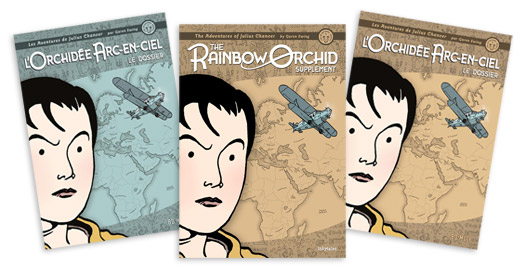
The main content of the Supplement consists of 15 pages of notes and annotations for the complete story, a bibliography, a cover sketchbook, a handful of interviews, some RO Christmas cards, character genealogy, and more. For this digital release I've added in a few extra-extras, namely some more Christmas designs, a previously unavailable (at least publicly) interview, and a little extra artwork. The original Supplement was 48 pages, this one stands at 54. None of this repeats the extras collected at the back of The Complete Rainbow Orchid.
Out of interest, the RO Supplement did see a French translation of a kind - if you purchase the three-volume set of L'Orchidée Arc-en-ciel from BD Must then you also get Le Dossier, a smaller (16-page) edition of the Supplement, featuring three truncated/edited interviews and some different artwork (largely in colour - my English edition is in black and white). There are two versions - a brown 'Collector's edition', and a blue 'Press edition' - both with the same content.
To download the free (English language) Supplement PDF, visit the shop, scroll down to The Rainbow Orchid Supplement and you'll see the link there. Enjoy!
Partly this was because I did get a handful of comments of the 'who does he think he is?' kind, and I fully agree with that. I am no big name, no famous dude, and no wise guru. But the second 'thought' on my list was:
You can learn from anyone, no matter what their level of expertise, no matter what their age is. Stay humble and be generous.
And while it's difficult to be both humble and promote a self-written blog post, I am publishing a follow-up in the spirit of hoping others might find some of these thoughts resonate with them in some way. It's quite likely you'll agree with a few and disagree vehemently with others. This is a personal list.
As I said last time, these are extracted from a file I've kept on my desktop for a number of years that I add to whenever a thought occurs that I want to keep. Some are born out of my own experience, and some are from observing fellow creators. All of them should be taken with a pinch of salt, and none are any kind of gospel!
The great thing about making comics is that if you do a not-too-good drawing then there's another opportunity with the very next panel.
Comics - the art is the page, not the panel; the reason is the story, not the art.
Personally, and generally, the fewer creators who have worked on a book the more interested I am. The optimum is one.
There is no quick fix to success. You need kung-fu - effort!
Once your book has been released into the wild, it must fend for itself. Let go.
What your peers think about your work is of interest, but what your readers think of your work is of value.
Don't 'write women'. Write people
Getting bad reviews as well as good ones is a sign that your book is reaching people outside the comfort zone of your friends and family. This is a good thing.
Don't give away your comics - people don't appreciate free stuff as much as the stuff that they've paid for. Give a discount, maybe, but your work is always worth something.
Publishers paying creators for original new comics, made to be comics, shows the health and value of a national comic industry.
To keep an artist going, give praise at least once a week.
If you really want to know a subject you mustn't just read about it, you must write about it.
In my comics the 'camera' is generally an observer, not an active participant, but this is just a preference, not a law.
Don't believe anything a publisher promises unless it is in black and white in a contract. And sometimes, even then ...
If you're drawing an interior scene, draw a little plan of the set, even if you don't see everything in the comic - it helps to keep the background consistent and you'll know what should appear in each view.
If there's something you find difficult to draw, make sure you include it in your story.
Every time I finish a story I want to out-do myself on the next one.
I favour the 'Victorian ankle' theory of drama and excitement. If you show too much, so much of the time, then dramatic events have less impact. Use action well.
The primary purpose of a publisher is not to be your friend, but to make money out of you.
It can take ten good reviews to wipe out the taste of a single bad one.
I want to make stories for swimming in, not paddling in.
Dialogue can be just as compelling as action.
People often say "it'll all be worth it - one day they'll turn your book into a film!". I'd rather they said "what a brilliant comic - it's just right!".
Would you like to know the magic ingredients that go to make a wonderful story? There are three: blood, sweat, and tears.
It's not the kind of pen you use that will improve your drawing, it's the kind of brain you use. How do you make your brain better for drawing? Draw, and keep drawing.
Children are not the next generation of comics readers. They're comics readers right now.
When people are critical of your work you either want to give up or you want to work harder and do better. Choose the second option and you'll have a greater chance of success.
You have to put yourself in luck's way in order to be lucky. Get your work out there.
Sometimes you have a wonderful idea, full of possibilities. Then you tell someone about it and it turns to ashes.
Yes, I do manga. I also do fumetti, bande dessine, manhua, historietas, strips, chitrakatha, serier ... Comics!
It doesn't matter how little it is, just make sure you do something productive each day, even half-an-hour. You'll feel better.
Gamers, stamp collectors, comics fans; these are not tribes, they're groups of individuals each with a hundred different other interests too. Don't lump.
There's great satisfaction in making a new story out of old facts.
No one sneezes in a story unless it means something.
Nostalgia and tradition are wonderful things - but don't hang on to them too tightly. Use them when you need to, but let them go just as easily.
You don't have a 'strong male character' so let's get rid of the 'strong female character' description too. We're all brave, cowardly, strong and weak. Actions should define character.
No one is owed a readership. Every single reader you gain is earned by the daily effort of creating your comic. If you have them, they are deserved.
Even your biggest fans will forget you once they put your book back on the shelf.
Don't be your own enemy with negativity and self-pity. It's difficult enough to have any kind of success without holding yourself back. Be your own best ally.
The less you charge someone, the more work they'll ask you to do.
Be an awkward author sometimes - be nice, but care about the details of your work.
Don't wait to be 'in the zone' before you start drawing. It won't happen. The only way to get 'in the zone' is to start drawing, usually when you're not 'in the zone'.
Is that artist better or worse then you? It doesn't matter, but I'd suggest you get off their path and get back on to your own!
My mission is to find people who like my work, not to force people to like my work.
To keep the fire burning you have to feed it with pages of art. It will keep going for a while without being fed, but before too long it will go out. Then you you have to make a big effort to rekindle that fire - it won't just happen. Best to keep it going.
Too many opinions can dilute an idea to almost nothing.
It's not how good you are at drawing, it's how good you are at ideas.
If you need to draw an animal, don't just look at still photos but look at videos of how they move as well - it will give you a feel for the creature and the drawing will be better.
Uphill: plotting, scripting, roughs and pencils; downhill: inking, colouring and lettering.
My favourite comic pages, from my own pen, are all due to storytelling, not the art. Even just a little success on the page makes it for me.
Art is exposing your vulnerability, and what's more human than being vulnerable?
Don't dismiss the power of understatement in comics, not everything has to be overacted with extreme gestures.
There's no such thing as a 'boring layout' for comics - it just has to be clear. If you think the layout is boring then the story is not doing its job.
The background is the Fifth Beatle. By that I mean sometimes it helps to think of environment as another character in the scene.
Don't fight the world - just do the best you can, with the things you're good at, in your own little corner of it. Lots of people doing that will have a greater effect than one person trying to do everything.
See part one here.

These are not official Osprey Games cards - they're fan art, and you have to make them yourself. You can do this by downloading the three card PDFs: Here's Julius , here's Lily , and here's Sir Alfred .
Try not to let them die in the jungle too often - I'm not sure how many lives comic characters have, and I might still need them for an adventure or two! Have fun ...

I have just finished writing a 6000-word article on the part of my family history that relates to the city of Lichfield - a piece 18 years in the making as it was an Edwardian postcard collection from Lichfield that came into my possession in the 1990s that started me off down my own genealogical rabbit-hole. Lichfield was my Mum's birthplace, so it has been the story I most wanted to uncover, and is the most interesting to me personally. Some of that Lichfield history relates to the Lees family of Haughton in Staffordshire, and it is one of these Lees that is the subject of this post.
Charles John Lees was born in Richmond Road, Derby, in December 1884. His father, John Lees (1857-1940), worked as a coachman and groom, and his mother was Eliza Jane Reeder (1851-1923), from Norfolk. He had one sibling, a brother, George William Lees, two years younger (1886-1960). Charles married Lucy Flower, the daughter of an iron moulder, in 1909, and a year later they had a daughter, Doris. In 1911, aged 26, Charles was described as an 'engineer's pattern storekeeper' - custodian of the moulds for use in an iron foundry. Two more children would follow - Herbert, in 1913, and Hilda in 1915.
Not long after Hilda's birth, with the flames of war now burning hot, Charles enlisted at Derby with the 16th Battalion Sherwood Foresters, also known as the Chatsworth Rifles. They landed in France in March 1916 and saw fierce fighting at the Somme, Ypres, Passchendaele and more. In October 1917, after heavy action at Shrewsbury Forest and during some downtime at the Wakefield Huts Camp at Locre, in between a number of matches of inter-platoon football, Charles wrote an informal (but official) Will, leaving everything he owned to Lucy. By now he was a Lance Corporal.
Just over a month later, in November 1917, the regiment found themselves serving several duties in the Polderhoek section near Gheluvelt (West Flanders). The action was consistent but not heavy, with 2 or 3 casualties from the unit a day. The Battalion war diary for the 19th November is typical for the month and reads ...
"The day was fairly quiet - intermittent shelling along the Menin Road and vicinity. Snipers were active from direction of Lewis House. Machine guns were very active at night traversing the front line and all approaches to the front line. 2 killed."
One of those two killed was Charles John Lees, dying on the day of his wife's 32nd birthday. The other was Private Henry William Blackwell, age 36. Whether either of them died from the shells, the snipers or the machine guns, I don't know.
Lucy would live on until the end of 1970, dying in Derby aged 85. Their three children would all marry, with the youngest, Hilda, dying in 2007, aged 91.
You can see more at my Family War Memorial (now with 30 researched entries), and even more at the War Archive (with almost 90 WWI names).

The Derby Daily Telegraph, 20 November 1918.

The game's author, Peer Sylvester, wrote a nice introduction to its creation over at Spielbar (in German, English Google translation here), and I thought I'd write a little bit about the art side of things.
I was contacted by Duncan Molloy from Osprey Games in March 2016, though due to technology getting the better of my initial replies perhaps it was a close-run thing that I was involved at all. Thankfully we overcame our computers' resistance and I got started on the cover at the end of July. Here are some of the early sketches ...

And below is the finished cover illustration, including box sides. Osprey's final design has featured a Tintin-style title graphic, which, along with my (not quite) clear-line artwork, seems to have resulted in it pushing the right buttons to give off that lovely high adventure vibe.

Next came the characters. At one point, early on, it was discussed (perhaps not too seriously) whether this could be a Julius Chancer game, which - although tempting - I wasn't in favour of. Firstly, it would probably limit the game's audience and, secondly, The Rainbow Orchid had been finished for four years and was now, naturally, seeing a decline in interest and sales.
As an aside, this was not the first time that Julius Chancer and his chums had been considered for a board game. In 2013 my publisher, Egmont, had a visit from the game designer Reiner Knizia and he expressed an interest in my book, the result being that they agreed to adapt his board game Tal der Abenteuer (Valley of Adventure) into a Julius Chancer game. Lots of possibilities come and go when you have a book, but this one got pretty far along, I think, before it petered out and entered the graveyard of dreams, where all the other might-haves and could-have-beens now lie.

Anyway, it was the right decision for The Lost Expedition because the characters that Osprey settled on are fantastic - they are all based on real people and I probably used up far too much of my time on research as they have such a fascinating backstory each, and there's some welcome diversity within the group as well. Here are my initial character sketches ...

In the game you only play three of the characters (though all six are involved in competitive mode), picking one with navigation expertise, one jungle specialist, and one with camping skill - there's male and female of each. My six-year old's favourite is Bessie, and I like her too - it's always a little more painful when she meets some grizzly end in the jungle, so try not to get too attached to them!

Illustrating the deck of adventure cards was the next phase, and probably the most daunting. Sixty-five cards in all (yes, I know the game only includes 56 ... so watch out for some bonus promo packs out there!) and the biggest workload of the project - but enormous fun, even if, sometimes, the research involved looking at some rather nasty stuff! I think initially the cards were intended to be smaller, my original brief mentioning 'poker-sized' cards (63.5 x 88.9 mm), but they've ended up being larger, at 78 x 119 mm, which seems to have had a largely favourable reaction from the gaming community.

The adventure cards are the engine of the game. The mechanics are fantastic and can, at times, be quite brain-taxing, but another big part of the enjoyment of The Lost Expedition is creating a narrative and telling the story of your explorers' jungle trek as you go along, and I like to think the illustrations play a big part in bringing that aspect to life for the players.
For instance, in the trail pictured below we find our adventurers risking the danger of a steep path, causing some serious injury but avoiding the lair of the looming crocodile in the process, and then finding themselves further on in their journey than they thought. They are then caught in a sudden tropical storm, meaning they have to set up camp quickly! When it's over they find the path they had intended to follow has been transformed, perhaps for the better - perhaps not. Hook worms - actually avoided thanks to the torrential rain in this example - must normally be dealt with either by having to stop and camp, taking damage from the infection, or using up valuable ammunition to burn them out. A nest of swarming insects means a sudden change in direction, using up navigation resources, missing the next encounter, and gaining new expertise of your surroundings. If the last card had come into play, then the vantage point would have been a bit of struggle to reach (loss of health) but would have allowed you to change upcoming events to your advantage and gain new knowledge of the terrain. You perhaps also spot something tasty for lunch - though you'd have to shoot it first!

The final component of the game for me to illustrate was the map cards. Although I had a basic idea of what the game was about, I didn't know the rules, so I was a little unsure about how to do these at first. At one point a miscommunication meant that I spent over a week drawing the cards in the wrong orientation (landscape instead of portrait). Osprey, kindly trying to accommodate, were going to look into adapting the artwork somehow, but I didn't want my art out there, on my first game, to be compromised or even fudged in some way (though I'm sure, with their standards, Osprey would have made it work), so I took a deep breath and redrew them - the right decision!
When you play The Lost Expedition you can play an easier game with seven map cards, or do the full trail with all nine. The cards are numbered on the back, and you place them in order, with number nine featuring the ruins of the lost city you're aiming for. But, actually - on the redraw - I designed the cards so they can go in almost any order (in pairs), and still match up.
1 and 2 always need to start, and 9 must always go at the end. 3-4 and 5-6 must always stay as pairs to match up, but they, along with 7 and 8 on their own, can be put in any order. So, you could go 1-2, 7, 5-6, 8, 3-4, 9 (pictured below). It doesn't make any difference to the mechanics of the game, but you can produce some different landscapes with it. (Incidentally, working out the card edges and the bleed for this system almost fried my brain on several occasions!)

I've played the game a handful of times now, in all of its modes, solo, cooperative, and competitive, and greatly enjoyed them all. I know I might be biased, but this game is right up my street anyway. I think Peer and Osprey have produced a really fine game with a ton of replayability.
The rulebook is available for download here (and even in Chinese, here) and Watch It Played did a great video overview here. With the UK Game Expo and Origins largely out of the way (it's the last day of Origins today), a few reviews are starting to creep out too - see here at Co-op Board games, here at Geek Girl Authority, here at Go Fatherhood, and here at Geek and Sundry for starters.
Go and grab yourself a copy - but be careful ... it's a jungle out there!
Edit: There is a short interview with me over at More Games Please about The Lost Expedition.
 previous