


This blog began in 1997 as a single news page called Nucelus. In 2005, during a long wait to move into a new house, I decided to learn some php and MySQL and write my own blogging system, which became inkyBlog and which now powers this, my own Webbledegook blog.
Thank you to my brother, Murray Ewing, for help with some of the more challenging aspects!

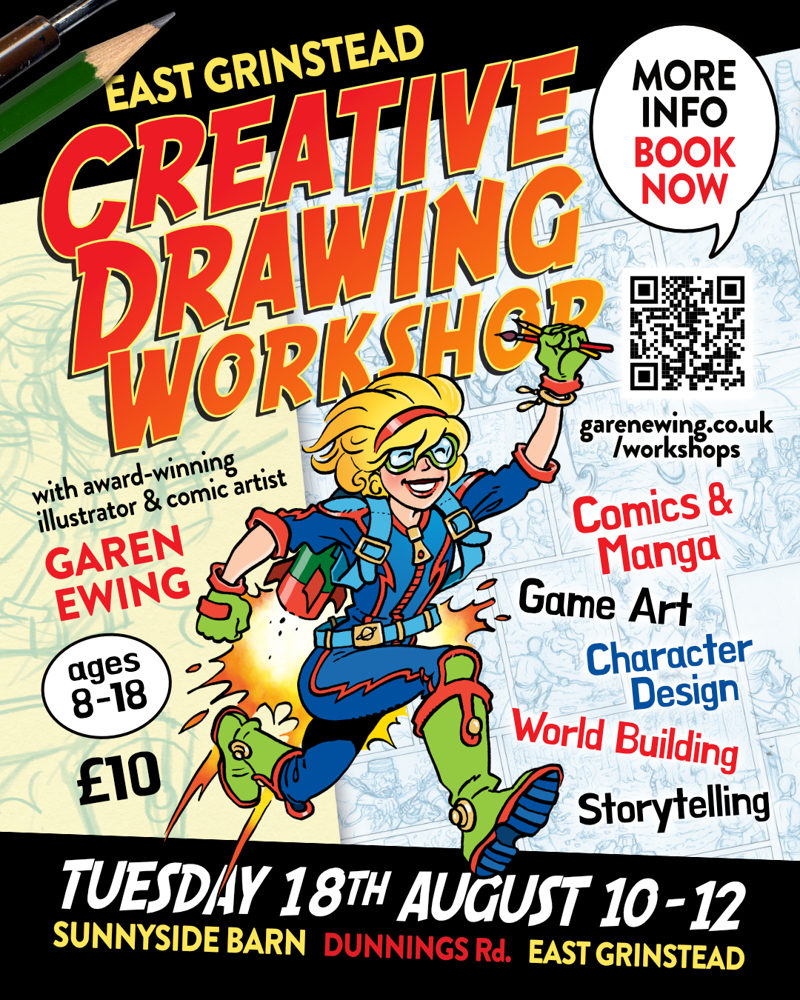
There are still a handful of places left (not many!) and you can book here if interested.
Recommended for ages 7+ and teens (or anyone, really!), you can book through the festival website here.
And have a look at the little video for it here.


My first introduction to Juillard was with his self-written After the Rain (Apres la Pluie, 1998), translated into English by NBM in 1999, and then via his masterfully illustrated Blake and Mortimer albums, seven in all, written by Yves Sente, from 2000's La Machination Voronov (The Voronov Plot), to 2016's Le Testament de William S (The Testament of William S). On one of my visits to Germany, in Colne in 2014, my German publisher very kindly gifted me two volumes of Juillard art books (Péle-Méle) - I often flick through them when inspiration is running a little low!

Juillard's beginnings included drawing classes from the likes of Druillet (Lone Sloane), Mézières (Valérian) and Jijé with his first published work in 1974 for Formule 1 (previously Cœurs Vaillants, the first home of Hergé's Tintin and Jo, Zette and Jocko in France). He soon established himself as a devotee of the historical comic, adapting Romeo and Juliet and debuting his 13th-century set story, Bohémond de Saint-Gilles.
Widespread success was slow to come, but did soon arrive with Les Sept Vies de l'Épervier (The Seven Lives of Sparrowhawk, seven volumes from 1983 to 1991), written by Patrick Cothias and set in France at the beginning of the 17th century. This lead onto the series Masquerouge (Red Mask, ten albums from 1984 to 2004, written by Cothias and then Marco Venanzi). Juillard also teamed up with Jacques Martin (creator of Alix and Lefranc) for a Napoleonic series, Arno (three volumes, 1983-1987).

Juillard's reputation was now without question, and more work, both in comics and illustration followed, with portfolios and art books released to continued acclaim. He won the Grand Prix at Angoulême in 1996. His last few albums included Léna (with Pierre Christin, three volumes, 2006-2020), Double 7 (with Yann, 2018) and a return to Les Sept Vies de l'Épervier (with Cothias, 2014 and 2021). Before his death he had been working on a new Blake and Mortimer album, the series' 30th, Signé Olrik (Signed Olrik), set in Cornwall, and scheduled for an October 2024 release.
There is no doubt the world of comics has lost one of its master creators, but André Juillard leaves behind a legacy of incredible work, a treasure-trove of bande dessinée art of the highest quality.


This was published back in 1994, and I've been tinkering with the idea of a remastered edition recently, which would include new scans as I currently only have scans of some old A4 photocopies, which are not the best.
It's very different work from the style I've developed since then - I always say I used The Tempest to get rid of all my fiddly little lines! But, while the drawing is less professional, I still have a great fondness for it.
Amongst the art are a few pieces that were never published, like these early character studies (with Ariel as more strongly female). No definite decisions yet, but it's interesting to see the work again after so long.

I've only been once, a very memorable trip back in 2014, but The Beat has included my brief views as part of their Angoulême Memories piece, including some who have been nearly 40 times (such as Paul Gravett).
For a trip down (my) memory lane you can read my blog report from the time here.

I mark his passing because he was principal artist on one of my favourite comics from the early 80s, The New Teen Titans (co-created with writer Marv Wolfman). My relationship with superhero comics lasted only a few years - from about 1980 to maybe the mid-80s, and The New Teen Titans was the one comic I made sure to seek out every issue, and is pretty much the only run of superhero comics I still have in my collection today (including many of its offshoots and rarities).

I was totally absorbed in those stories - Brother Blood, Deathstroke, Terra, the Brotherhood of Evil, Trigon, the Vigilante, the runaways - just some that have stayed with me after decades. I carried on with the Teen Titans after George left - but it was never the same and my interest quickly petered out (though I did go back and collect the original 1960s Teen Titans run with the also-fabulous Nick Cardy, and I was very happy when José Luis García-Lopez made a guest appearance on art chores of The New Teen Titans too).

But the work and style of George Pérez is forever impressed into my brain from those early-80s formative years of comics reading, in the same way many of the classic 2000AD artists are, Joe Colquhoun from Battle, or the best of the contributors to Warrior. His work went way beyond the Teen Titans - including memorable runs on Crisis on Infinite Earths and Wonder Woman, which I also encountered to a much lesser degree.
So thank you George for the joy and inspiration you added to a very happy period in my own life. It's sad he's gone, but what a fantastic legacy - I'll be digging out some of my old comics for a re-read.

His body of work was incredible in both quality and scope, and I would have been reading his strips in various British weeklies long before I knew who he was. He designed Judge Dredd, and became one of the character's cardinal draughtsmen. The first strip of his I became obsessed with was Strontium Dog: Portrait of a Mutant (1981), and the next was Judge Dredd: the Apocalypse War (1982), both classics that have stood the test of time. I read and re-read those stories, and examined his art until I could conjure up many of his iconic images at will, enjoying them again in my mind's eye rather than concentrating on the maths I was supposed to be doing at school. Every line he drew crackled with energy and every panel jolted the story into vivid life.

The reaction ranged from calling Tommaso 'entitled' and 'arrogant' to solid support for his rant and empathy for his view. While there may have been a little truth to some of the criticisms (not including the ill-mannered name-calling) I could also sympathise - literally years of intensive work resulting in pitiful financial returns is why so many creators can't make a living from comics alone, or even spare the time to make them.
Of course the negative reaction to this view is because artists and writers are supposed to be grateful for even being able to touch the hem of a career in art, let alone get paid for it. There's still an attitude that such vocations should be done 'for the love of it' (as if you can't get paid for something you also love), even going so far, sometimes, as viewing any financial remuneration as a form of 'selling out'. Little understood among many outsiders is the fact of the increased burden on mental health that goes with doing something you are so passionate about, often resulting in an extreme love/hate relationship with the thing you're supposed to comfortably enjoy. Making comics is rarely a comfortable occupation.

It is true that no one is owed an audience. There's a market out there, and success in it can largely depend on whether you've made something that large numbers of people actually want to read. But first that market has to be made aware of the art in question and there are many stories of wonderful comics dying on the vine thanks to poor awareness or marketing. It's a challenge for both creators and publishers.
Thankfully, Tomasso's post, as well as opening a useful discussion, helped to heighten awareness of Spy Seal and resulted in an increase in sales, eventually leading to the publication of four issues and, in January 2018, a collected album.
It's a great book and I heartily recommend it. The drawing is very clean, almost severely clear line, but still retains charm and enough character to feel alive with movement. The design aesthetic is lovely. It's funny and mysterious in just the right measures and, while the obvious comparison may be with Hergé (there are numerous direct nods to specific Tintin adventures), it also put me in mind of the super Michael Crawford film, Condorman. Tommaso cites Danger Mouse as another influence, and I can see that too.
Spy Seal - The Corten-Steel Phoenix is published by Image Comics, runs to 96 pages, and retails for £11.99. I hope there'll be more to come.

I also want to give mention to Colin Mathieson's latest collection, Moments of Adventure 2. This was published through Accent UK last year and collects some of Colin's contributions to their anthology titles such as Robots, Pirates, Monsters and Remembrance Day.
I really love Colin's short stories, they always work well and contain a lot of heart, the theme often lingering beyond the closing of the covers. The colouring, this time by Aljoša Tomiĉ, adds a lot to Colin's art style and I hope there will be more work to come in this vein.
Moments of Adventure 1 and 2 are available from the Accent UK website.
And if you ever find yourself near the National Army Museum in London, make sure you check out Colin's work in their 'Story of British Military Comics' display, for which he worked on several pages (with colourist Matt Soffe) - a fantastic thing.

On a personal level, I'm pleased to see Corben recognised - he has long been a favourite of mine, though I must admit I have not been following his work over the past 18 years or so. I was, I think, 16 when I first came across his art - seeing just a tame panel or two from his 1978 "illustrated epic adventure of fantasy and magic", Neverwhere, I put it on my Christmas list and my younger brother bravely bought it for me. Seeing the full book for the first time was a bit of a shock for this rather sheltered young lad - most of the characters went around totally naked, baring their weighty anatomy without so much as a blush.
But once I got over that (and making sure my Mum never saw it), the main aspect that struck me was the solid vivaciousness of the art - the painting was incredible (how could someone produce so many pages of such detail and intensity?) and the characters were alive, squashy flesh, elastic muscle, poses I hadn't seen in comics before, expressions that conveyed everything, all bathed in light and shadow that made the drawings feel like tactile models.
The fight scenes in particular stood out - they were bone-crunchingly real, enough to make you wince while reading. Faces concertinaed under the weight of a fist, leg bones snapped from the force of a thrust kick that looked as though Corben must have studied martial arts at some point.

Corben quickly became my favourite artist (a panel here and there in my comic Realm of the Sorceress was directly copied from his work) and I sought out more of his stuff - not easy in that pre-internet era, when much of what was available was sold by specialists far away across the Atlantic. I got hold of the Complete Underground volumes, as well as Mutant World, Werewolf and Bloodstar. I discovered a sequel to Neverwhere, Muvovum, a work I found difficult to digest due to the unflinching physical detail of the monsters depicted.
Another to keep away from my Mum was The Bodyssey, though I preferred some of his more mainstream adaptations such as The Last Voyage of Sinbad (with Jan Strnad), Vic & Blood (Harlan Ellison), and, produced later, one of my favourite novels, William Hope Hodgson's The House on the Borderland.
I've no doubt some of his work could be described as quite sexist, though perhaps it could also be argued that the men had equal rights when it came to nudity, and, contrary to what Le Figaro says, many of his female characters were intelligent, strong, and usually got the better of the often simpleton men - but you have to read the stories to see that. Then again, perhaps it doesn't help too much when viewed within an industry (comics) that already overwhelmingly objectifies women within its most visible genre (superheroes).
Another favourite, from the Collected Underground volumes, was Rowlf, the tale of a girl and her pet wolf - the Japanese genius of animation, Hayao Miyazaki, liked it so much he started to adapt it as a possible film project. One can only dream what that would have been like!
I drifted away from Corben after a while - perhaps much of his work was more suited to the male psyche when in its late-teen and early-twenties, and my interest in horror, especially graphically violent horror, quickly disappeared - though it really was his art that astounded me more than any attraction to the titillation or story content (a mixed bag) - and that has stayed with me to this day, particularly in the way I think about fight scenes in my own comics.
So, congratulations, Mr Corben - I should perhaps go and see what changes the new century has brought to your amazing work, and I hope there are many more projects yet to come.
